
I don’t know the year but I was old enough to remember Dad saying that he was going to buy a fishing pole and that we would go fishing. Could it be that the idea of fishing would bring in a nutritious source of food to the Depression era dinner table, or was it that Dad just decided that fishing would be a good sport? As it evolved, fishing became a regular part of our family’s life, not only as a sport but as a frequent supply of food for the table.
Aside from some occasional forays to various fishing spots all around western New York state and adjacent Canada, including Buffalo’s own Delaware Park Lake, there were a few places that became regular favorites. The most favored was Sturgeon Point on Lake Erie south of Buffalo. Another was Port Colborne, Canada, at the southern terminus of the Welland Canal on Lake Erie. A third place was Port Maitland, Canada, at the mouth of the Grand River where it empties into Lake Erie. Fishing expeditions taking longer than a day included a vacation on a small lake near Kingston, Ontario and a few days on the Georgian Bay off of Lake Huron.
Sturgeon PointIn those days, the interstate system was not in place so that to go to Sturgeon Point, about 25 miles from our east Buffalo home, required driving through south Buffalo, through the southern suburb of Lackawanna, and then into the countryside along Lake Erie shore. As a youngster, the trip to the fishing grounds was always filled with fascination and anticipation of catching fish. The route through south Buffalo went through the industrial area consisting of all sorts of manufacturing plants but particularly of chemical companies such as Allied Chemical and National Aniline. In the days before there was much attention to pollution control, the air was always heavy with nauseous odors. Steaming discharges flowed out of pipes from the plants into the Buffalo River, a serpentine stream crossed several times in route, which eventually emptied into the Niagara River. To this youngster, rather than off-putting, these experiences were a source of curiosity and wonderment.
Approaching the shores of Lake Erie as it necks down to become the Niagara River, there was a line-up of gigantic grain elevators that would be filled with the harvest of cereal products from the bountiful Midwest. Next came the massive industrial behemoths of the Iron Age, the blast furnaces of Lackawanna Steel and Bethlehem Steel. Interspersed among the black belching smoke stacks, there were massive piles of coal brought in by train from the Pennsylvania coal fields, and gigantic piles of iron ore brought in by lake freighters from the Lake Superior iron ore mines. Finally there were stretches of slag piles, the waste product of steel making, some of it still glowing orange hot, just dumped by special rail cars coming from the blast furnace buildings.
If we were coming home from fishing at dusk or at night (night fishing is another story), one could get a better view of the red glowing furnaces, spewing out sparks, steam and smoke. At the time, these seemed like some chaotic inferno, symbols of the throbbing energy of the Industrial Age. Now, with images of the space age in our minds, they might be described more like the blast-off fury of a space rocket.
But now the space age is passé. In the 21st century, with the Lackawanna steel industry shuttered, their structures have been demolished and replaced by brown fields. The area has been turned into a wind farm, the turbine towers as tall as the smoke stacks they replaced, taking advantage of the breezes that are constantly blowing off Lake Erie.
At Sturgeon Point, a small fleet of rental row boats was sheltered by an inverted L-shaped sea wall. Early on, Dad and my Uncle Joe, who often accompanied us, would row a boat out into the lake to a spot where they believed the fish to be. Many boats seemed to agree that this was a good spot because there developed a small community of boats dotted around the same general area. There would be an exchange of chatter among the boats about how well fishing was going today: “How are they biting?” – “What bait are you using?” When the catch was slow or non-existent, there became a certain restlessness among the community of boats. One by one, they would wander a few hundred yards to the left or right, or head out farther into the lake.
Later on Dad purchased an outboard motor that would be attached to the stern of the rented boat. This was a two horsepower (HP) Johnson Marine outboard motor. In a few seasons this was judged to be too slow so Dad upgraded to a 5 HP Johnson outboard. Today, as a casual observer, I have never seen a Johnson outboard, or for that matter an Evinrude which was a good competitor of Johnson in those days. Today the outboard motor market is totally dominated by Yamaha.
Dad constructed a sort of saw horse stand that supported the outboard motor when not in use, especially through the winter season. As the summer fishing season approached, it needed to be serviced and tested to make sure it would start easily. This was done by attaching the motor to a wine barrel that my family had used to make wine years previously. I was instructed to clean out the barrel of accumulated leaves, and to fill it with water in preparation for testing the motor on the week end.
Port Colborne, Ontario
The Welland canal cuts through the Niagara escarpment, thus allowing shipping on the inner Great Lakes to bypass Niagara Falls and to join Lake Ontario. Eventually, the Saint Lawrence Seaway opened up lake shipping all the way to the Atlantic Ocean. The actual fishing location at Port Colborne was on a dock on one of the many side channels near the canal that served as transfer points for lake shipping. The particular dock from which we were accustomed to fish was adjacent to a grain elevator. The surrounding area was rather dismal so this was the least favorite of mine. However, this seemed to be a place where the probability of a good catch was high. I wondered why this was so: It was explained that the water was very deep near the dock to accommodate large lake freighters. Secondly, during the unloading of grain from the holds of the ship, there inevitably was a loss of some grain, blown by the wind, into the surrounding water. Consequently, there were always fish in the vicinity anticipating the largess of a good feeding not unlike tropical fish anticipating the sprinkling of food from above in a home aquarium. Hopefully, the fish would be satisfied with our bait in the absence of a freighter unloading.
Port Maitland
Port Maitland, near Dunnville, Ontario and about fifty miles from home, featured a long concrete pier with a lighthouse at the end. The pier sheltered the estuary of the Grand River as it empties into Lake Erie. On the left side looking toward the lighthouse is the Grand River, while on the right is the sandy beach of the Lake. For a youngster, these features made Part Maitland a fun place. The pier provides an excellent fishing experience on either the river side or the lake side. The lighthouse at the end and the pile of large limestone rocks at the end of the pier provided lots of possibilities for clambering about down to the water’s edge for someone whose fishing attention span was not as great as an adult’s. The beach on the lake side also offered opportunity for playing in the sand as well as for swimming.
Why is such a place such a good fishing spot?: Just as at Port Colborne, fish come out of the lake to hover near the estuary in anticipation of food being washed down the river from the interior. Indeed, a greater proportion of fish caught here were often the larger species than the pan fishes more often caught in the lake itself.
Kingston, Ontario
Virtually all our fishing trips to the places mentioned above would be called day trips. There were a couple of exceptions that I remember: In 1939 my parents and my Aunt Gertrude and Uncle Joe rented a cabin on a lake in Canada The place was always referred to as “Kingston” but Kingston, Ontario is on Lake Ontario, and I specifically recall a cabin on a small lake. It must have been that Kingston was the nearest city and the lake was somewhat inland from Kingston proper.
My Dad and Uncle Joe would get up early to fish and by noon would return to the cabin with a large catch. Our family album had several photographs of various combinations of my Mother, Father, Aunt Gertrude, Uncle Joe and me standing by the cabin, showing off strings of freshly caught fish. We ate fish for breakfast, lunch and dinner.
In the afternoon, I was permitted to use the boat on my own to row about the lake. This is where I learned my seamanship.
Fishes caught
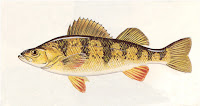 |  | 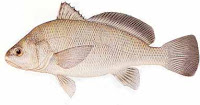 |
| Yellow Perch | Great Northern Pike | Sheephead |
We caught a wide variety of fish in the 1930s and 1940s. But by the 1950s the species mix began to change and catches were less certain and diminished in size. The most common fishes caught in Lake Erie were yellow perch and rock bass. More prized because of their larger size were blue pike and the less common yellow pike (also know as walleye pike or pickerel). The most prized of all was the great northern pike. Another large fish was sheepshead (also known as fresh water drum) of great interest to me not only because this fish is a strong fighter but because of a bony disc about the size of a dime located in its head. In season, small mouth bass were also common. Less common were bull heads (related to cat fish), but a delight to catch because of their sweet meat.
Epilogue Part 1
These stories are recorded here to tell how important fishing was in the life of my father and my family as told through the eyes of a youngster. As mentioned above, fishing in the waters around Buffalo was reasonably successful with a wide variety of fish being caught. However, starting in the 1950s, more and more frequently we would come home empty handed. By the late 1960s Dad just about gave up on fishing. The lake had become polluted. For reasons unknown the lamprey population exploded in the late 1940s and 1950s and this decimated the local fish population. This was a great disappointment to Dad.
Epilogue Part 2
Without any proof, I would like to speculate that the experience of a youngster sitting in a boat with only your father and possibly also with your uncle, essentially isolated from the distractions present on land must have had some developmental effect. Sometimes, after prolonged silence watching the gentile rolling of the waves, occasionally interrupted by a dialogue about how the world works, or when the catching is good and there became a competition about who could catch the most fish, or when the catching was not good and there was finally a realization that we would go home empty handed, -- all this must have an effect on an impressionable youth.
The repeated trips through the industrial area of Buffalo to the fishing grounds must have had an effect too. The fascination of what was must be going on inside those stinking buildings, the sense of power exuding from those monstrous steel plants created a desire for participation that I now attribute to my eventual career in science. It is that same process, but in another context, that prompted Barack Obama to comment “that such moments accumulate and embed themselves in a child’s character becoming a part of their soul.” * My Dad could have made a different choice of sport in the 1930’s and perhaps the outcome on my life option points might have been the same or different. There is no way to tell. But in any event I am totally content with the way things turned out.
* Barack Obama, Audacity of Hope Vantage Books, N.Y., 2006, p. 413.
Readers of this blog may also be interested in other fishing related posts:
- Fishing: Ice Fishing
- Fishing: Casting
- Fishing: Night Crawlers
- Fishing: Sinkers

 Braiding of the strands is the next step. The strands often were not made from the same remnant material. Hence, there is the opportunity to select combinations of three remnant sources to create rugs with different color designs. Here the judicious selection of contrasting or complimentary colors ultimately determines the aesthetics of the rug. All three strands of fabric could be the same color, or two the same, or none the same. However, the selection of the color choice of the strands was often primarily determined on what was available from Aunt Gertrude at the time.
 We had one braided rug in Jenkintown which eventually was relegated to the basement and then to the garage. But, alas, when the garage was converted into an artist studio the light orange braided rug, still sturdy and strong but now quite soiled and water stained, it had to be discarded after some 40 years of ‘rugged’ service.


